

How to Choose PVC Foam Board for Promotional Campaign Displays
Promotional display projects must balance printing, cutting, assembly, packaging, transportation, and store installation within a limited budget.
An underspecified board may cause panel bending, shelf sagging, torn slots, or an unstable display. An overspecified board increases material weight, machining time, packaging volume, and shipping costs.
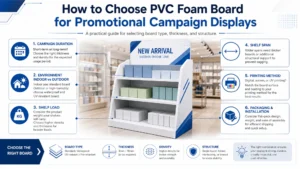
Before requesting a quotation, buyers should confirm five conditions:
- Campaign duration and operating environment
- Whether each component provides visual display, load-bearing support, or structural connection
- Product weight per shelf and the unsupported shelf span
- Printing and cutting methods
- Packaging, transportation, and store installation requirements
Suppliers should use these conditions to recommend a suitable Free foam, Celuka, co-extruded, or other PVC foam board grade. They should not base the quotation only on board thickness and average density.
The specifications below provide a starting point for the first prototype. They do not represent universal load-bearing guarantees. Buyers should confirm the final solution through the actual display structure and prototype test results.
1. Confirm the Campaign Duration and Environment
Campaigns Lasting 1–4 Weeks
New product launches, holiday promotions, exhibitions, and temporary window displays often remain in use for only a few weeks.
For non-load-bearing signs, back panels, and decorative surfaces, buyers can consider thinner and lighter boards to control material and transportation costs. However, shelves, bases, and connection points must still meet the actual load and installation requirements.
For a short-term campaign, the prototype should confirm that:
- The printed panels remain flat
- The fully loaded structure remains stable
- The display survives packaging and transportation
- Store employees can install it correctly
A short campaign does not eliminate structural risk. It only reduces the length of time during which the board must resist continuous loading, handling, and environmental exposure.
Campaigns Lasting 1–6 Months
Quarterly promotions, branded retail zones, multi-store campaigns, and reusable displays must withstand continuous product display, restocking, cleaning, movement, and repeated installation.
These projects require stronger performance in several areas:
- Long-term stability of shelves and bases
- Local strength around slots, hanging holes, and screw holes
- Impact resistance along exposed board edges
- Connection stability after repeated assembly and disassembly
As the campaign period increases, buyers should pay more attention to shelf deformation and loose connections under continuous loading. Checking only the first assembly does not provide enough information.
A shelf may appear stable immediately after installation but gradually sag after carrying products for several weeks. Prototype testing should therefore reflect the expected display period whenever possible.
Outdoor or High-Temperature Locations
PVC foam board resists moisture and water exposure, but this does not mean that every grade can withstand long-term sunlight, temperature changes, or wind pressure.
When the display will stand outdoors, near a glass window, close to lighting equipment, or in direct sunlight, buyers should also confirm:
- Whether the board, ink, and protective film suit the actual environment
- Whether large panels require additional fixing points
- Whether dark printed surfaces may absorb heat and deform
- Whether the installation structure allows thermal expansion and contraction
- Whether wind pressure may affect large signs or unsupported panels
Buyers should assess outdoor projects with a fully printed prototype under realistic installation conditions. The statement “PVC is waterproof” does not provide enough information for material selection.
2. Classify the Display Components
A promotional display should not automatically use the same PVC foam board type and thickness for every component.
Buyers can first divide the structure into three component groups.
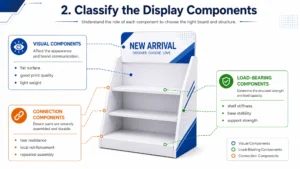
Visual Components
Visual components include header signs, back panels, graphic panels, and decorative surfaces.
These components mainly require:
- A flat and consistent surface
- Reliable print quality
- Suitable weight
- Acceptable resistance to warping
Because visual components usually do not carry product weight directly, buyers can often control their thickness and material cost more aggressively.
However, large-format panels may still bend because of their dimensions, installation direction, fixing method, or one-sided printing. Board size and support conditions remain important even when the component does not carry products.
Load-Bearing Components
Load-bearing components include shelves, bases, vertical columns, and main support panels.
The primary risks include:
- Shelf sagging
- Base deformation
- Unstable centers of gravity
- Structural failure during movement or restocking
These components require higher bending stiffness. Depending on the display structure, the supplier may also need to add a central support, front reinforcement strip, back support, or double-layer construction.
Increasing board thickness alone does not always provide the most efficient solution. A properly positioned support can reduce the shelf span and improve performance more effectively.
Connection Components
Connection components include slots, hanging holes, screw holes, bonded joints, and interlocking areas.
These areas experience concentrated stress and may suffer from:
- Tearing
- Crushing
- Enlarged holes
- Damaged slot edges
- Loose connections after repeated assembly
Connection points often require a board grade with a harder surface or local reinforcement. Buyers should not automatically increase the thickness of the entire display just to strengthen several small connection areas.
Local reinforcement may include additional board layers, washers, inserts, support blocks, reinforced edges, or redesigned slots.
3. Match the Board Type to Each Component
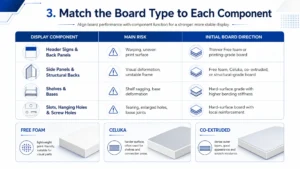
| Display component | Main risk | Initial board direction |
|---|---|---|
| Header signs and back panels | Warping and uneven printing surfaces | Thinner Free foam or another printing-grade PVC board |
| Side panels and structural back panels | Visual deformation and unstable frames | Free foam, Celuka, co-extruded, or another structural-grade board |
| Shelves and bases | Sagging and base deformation | A specific grade with a harder surface and higher bending stiffness |
| Slots, hanging holes, and screw holes | Tearing, enlarged holes, and loose connections | Hard-surface board with local reinforcement |
Free Foam PVC Board
Lightweight Free foam PVC board commonly serves printed signs, background panels, and non-load-bearing decorative components.
Some softer Free foam grades may require local reinforcement around slots, hanging holes, and screw positions. However, this does not mean that all Free foam boards lack structural performance. Some structural-grade Free foam products may suit specific load-bearing applications after testing.
Celuka PVC Foam Board
Celuka board generally has a harder outer surface and a foamed core. Manufacturers often consider it for shelves, bases, machined edges, and slotted connection areas.
However, the word “Celuka” alone does not guarantee sufficient load-bearing performance. Density distribution, skin hardness, cell structure, thickness tolerance, and production quality can vary between manufacturers and grades.
Buyers should confirm the final selection through the specific board grade and prototype structure.
Co-Extruded PVC Foam Board
Co-extruded PVC foam board usually combines a denser outer layer with a foamed core.
This structure can suit components that require a combination of:
- Good printing appearance
- Scratch resistance
- Machining performance
- Harder surfaces around edges and connection points
The exact performance still depends on the surface layer, core structure, total thickness, and manufacturing process.
Select the Actual Grade, Not Only the Board Name
Lightweight printing-grade Free foam board often suits visual components. Shelves, bases, and connection areas usually require a specific grade with a harder surface, more stable cell structure, and higher bending stiffness.
Suitable grades may come from Celuka, co-extruded, or structural-grade Free foam production.
Buyers should therefore evaluate:
- The actual board grade
- Surface hardness
- Cell structure
- Thickness tolerance
- Bending performance
- Machining quality
- Prototype results
Board names, nominal thickness, and average density do not provide enough information on their own.
4. Check Shelf Span and Product Load
Buyers frequently provide only one figure, such as “the complete display must carry 10 kg.” This figure does not provide enough information to select the shelf specification.
The supplier also needs to know:
- The product weight on each shelf
- The distance between the actual support points
- Whether the products sit evenly across the shelf or concentrate near the center
- Whether the shelf will carry the load for several weeks or several months
- The shelf depth and loading direction
- Whether the shelf has front, back, side, or central reinforcement
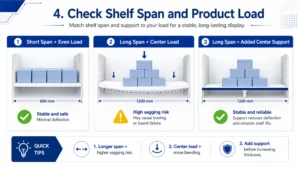
Three basic rules help guide the initial design:
- A longer unsupported span creates a higher sagging risk.
- A concentrated center load creates more risk than an evenly distributed load.
- Adding a central support often costs less than increasing the thickness of every component.
For example, a 500 mm-wide shelf and an 800 mm-wide shelf without central support should not use the same design simply because both carry 10 kg.
The longer shelf experiences a much greater bending effect. Shelf depth, support direction, product position, and continuous loading time will further affect the result.
For shelves around 800 mm wide or wider, suppliers should first consider:
- A central vertical support
- A reinforced front edge
- A back support strip
- Local double-layer construction
- Shorter unsupported sections
- A revised shelf orientation
After optimizing the support structure, the supplier can determine whether the project still requires a thicker or higher-performance board.
Without adequate support, even a thicker board may gradually sag during long-term product display.
Total Load Is Not the Same as Shelf Load
A display carrying 20 kg in total does not necessarily require every shelf to carry 20 kg.
For example, a four-shelf display with an evenly distributed total load of 20 kg may carry approximately 5 kg per shelf. However, the supplier must still account for uneven restocking, temporary overloading, product concentration, and handling during store use.
Buyers should provide the expected load per shelf rather than only the total display load.
Continuous Load Requires Separate Testing
A short loading test may identify immediate structural failure, but it may not reveal long-term deformation.
For campaigns lasting several months, the prototype should remain fully loaded for a suitable observation period. The test should measure shelf sagging, connection movement, and base deformation over time.
The supplier should document the product arrangement during the test because changing the load position can change the result.
5. Consider Printing, Packaging, and Installation
Material selection cannot remain separate from printing, packaging, and installation. Each process can affect panel flatness, edge condition, connection strength, and final display performance.
UV Direct Printing
For UV direct printing, buyers should confirm:
- Board flatness and thickness consistency
- Surface color consistency between production batches
- Ink adhesion
- Warping after large-area printing
- Edge quality after cutting
- Resistance to scratching during assembly and transportation
Large-format signs should use a test panel close to the final production size.
A small print sample can check color and ink adhesion, but it cannot fully reproduce the bending and warping risks of a large printed panel.
The printer should also confirm whether curing heat, ink coverage, or one-sided printing may affect the board.
Printed Film or Adhesive Vinyl
For film-laminated projects, buyers should check:
- Film adhesion
- Lifted edges
- Film condition around routed slots and holes
- Surface bubbles
- Panel bending after large-area, one-sided lamination
- Cutting quality along film-covered edges
When warping occurs, the supplier can consider balanced treatment on the back surface, an additional frame, a different film system, or another board grade.
The supplier should not automatically increase the thickness of every display component without identifying the source of the warping.
Flat-Pack Delivery
Flat packing reduces shipping volume, but it transfers more assembly risk to the store.
When ordinary store employees will assemble the display, the structure should include:
- Clearly numbered parts and slots
- As few separate components as possible
- Designs that prevent incorrect left-right installation
- Image-based assembly instructions
- Connections that do not require complex tools
- Parts that fit without excessive force
For displays that require repeated assembly and disassembly, suppliers should strengthen slots, holes, and connection edges.
The prototype should also confirm whether components remain flat and undamaged after packing, stacking, transportation, and unpacking.
Fully Assembled Delivery
Shipping the display as a finished unit reduces store installation work, but it increases:
- Packaging volume
- Freight space
- Corner and edge damage risk
- Requirements for internal protection
- Handling difficulty during transportation
Fully assembled delivery may suit projects with complicated structures, short installation schedules, or stores without assembly personnel.
Flat packing usually provides a cost advantage when the campaign covers many stores, involves long-distance transportation, or uses large display units.
Buyers and suppliers should determine the board specification, connection design, and packaging method together. Changing the packaging method after structural approval may create new risks.
6. Initial Selection Guide for Prototype Sampling
The following table provides an initial direction for the first prototype. Product load, board grade, installation direction, shelf depth, and support structure will still affect the final solution.
| Application | Initial selection direction | Main prototype checks |
| Small indoor signs | 3–5 mm Free foam or another printing-grade board | Flatness and warping after printing |
| Signs or hanging panels wider than approximately 600 mm | Start evaluating from 5 mm and adjust according to panel height, fixing points, and installation direction | Panel bending and tearing around holes |
| Small countertop displays | Start side panels at approximately 5–8 mm and adjust the base according to load and center of gravity | Base deformation and overall stability |
| Shelves with a support span of approximately 400–600 mm | Start prototype testing with a 10–12 mm hard-surface grade, then adjust for shelf depth, load, and support structure | Shelf sagging under full load |
| Shelves with a support span above approximately 600 mm | Add a central support or reinforcement strip before relying on thickness increases | Deformation under continuous loading |
| Structures requiring repeated assembly | Use a hard-surface grade and reinforce connection areas locally | Enlarged slots and loose connections |
These ranges do not represent universal load-bearing standards. They only help narrow the material options for the first prototype.
The prototype should verify four main results:
- Printing flatness
- Stability under full product load
- Strength around connection points
- Condition after packaging and delivery
For long-term displays, buyers should also add a continuous-load observation test.
Record the Prototype Conditions
A useful prototype report should record:
- Board type and specific grade
- Nominal and measured thickness
- Board density, when relevant
- Shelf dimensions
- Unsupported span
- Product weight per shelf
- Product loading position
- Support and reinforcement details
- Packaging method
- Test duration
- Observed deformation or damage
Without these details, buyers cannot reliably compare different prototype versions or repeat the approved result during production.
7. Information Required for a Material Recommendation
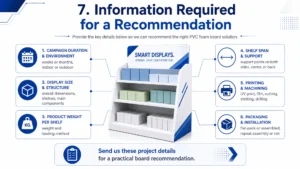
To receive an effective material recommendation, buyers should provide at least six groups of information.
1. Campaign Duration and Environment
State whether the display will remain in use for several weeks or several months.
Also identify whether it will stand:
- Indoors
- Outdoors
- Near a window
- Close to lighting equipment
- In direct sunlight
- In a high-temperature or humid location
2. Display Dimensions and Structural Drawing
Provide the overall dimensions, number of shelves, shelf depth, and main component layout.
A dimensional drawing, structural sketch, rendering, or existing sample photo will help the supplier understand the actual support system.
3. Product Weight per Shelf and Loading Method
Do not provide only the total display load.
State:
- The weight carried by each shelf
- The number of products per shelf
- Individual product dimensions
- Whether the products spread evenly or concentrate in one area
- Whether store employees may temporarily overload the shelf during restocking
4. Shelf Span and Support Positions
Show whether each shelf receives support from:
- Both side panels
- A central divider
- The back panel
- A front reinforcement strip
- Vertical columns
- Additional brackets or frames
The supplier needs the distance between actual support points, not only the total shelf width.
5. Printing and Machining Requirements
Confirm whether the project requires:
- UV direct printing
- Printed film or adhesive vinyl
- Cutting
- CNC routing
- Slotting
- Drilling
- Screw connections
- Adhesive bonding
- Edge finishing
These processes affect the required surface quality, edge strength, dimensional tolerance, and board grade.
6. Packaging and Installation Method
State whether the supplier will ship the display flat-packed or fully assembled.
Also confirm:
- Whether the display requires repeated assembly
- Who will install it
- Whether installers can use tools
- Whether the package will travel by courier, air, sea, or local truck
- Whether several display sets must fit into one carton
- Whether the project requires assembly instructions or numbered components
The supplier should use this information to select separate board types, thicknesses, and reinforcement methods for visual, load-bearing, and connection components.
Conclusion
Selecting PVC foam board for promotional displays should not begin with one standard thickness for the entire structure.
Buyers should first identify the function of each component.
A practical material configuration often follows these principles:
- Use lighter, print-friendly boards for signs and decorative components.
- Use specific grades with higher bending stiffness for shelves and bases.
- Reinforce hanging holes, slots, and screw holes locally.
- Add support to wide shelves before increasing the thickness of the complete display.
- Adjust the connection design according to flat-pack or fully assembled delivery.
- Use a prototype to confirm printing, loading, connection, assembly, and delivery risks.
This component-based approach can maintain display stability throughout the campaign while controlling material, machining, packaging, and transportation costs.
Send Us Your Project Requirements
Please provide the display dimensions, product weight per shelf, shelf support span, printing method, campaign duration, and packaging requirements.
As a PVC foam board manufacturer, we can evaluate the project conditions and recommend an initial board grade and thickness.
We can also:
- Cut components according to your drawings
- Machine slots and holes
- Prepare custom-sized panels
- Produce a prototype display
- Test printing and assembly performance
- Verify product loading and packaging conditions
Prototype testing allows both parties to confirm the material, structure, printing, assembly, and delivery solution before mass production.
